Introduction to Peterborough United Legendary Players
The Legacy of Peterborough United
Founded in 1934, Peterborough United entered the Football League in 1960 and quickly developed a reputation for entertaining, attacking football. Based at London Road—now known as the Weston Homes Stadium—the club has enjoyed multiple promotions across the EFL, producing and nurturing a host of influential players.
From record-breaking goalscorers to modern-day creators, Peterborough’s history is built on flair, tenacity, and a knack for unearthing talent. Across the decades, certain individuals have defined entire eras, leaving legacies that stand out for their consistency, leadership, or goalscoring heroics.
Criteria for Ranking the Best Players
This ranking is based on verified achievements including total appearances, goals, promotion campaigns, individual accolades, and influence across different eras.
Every player has been selected through factual criteria, avoiding sentiment or speculation. Only players whose impact is well-documented and measurable at Football League level have been included.
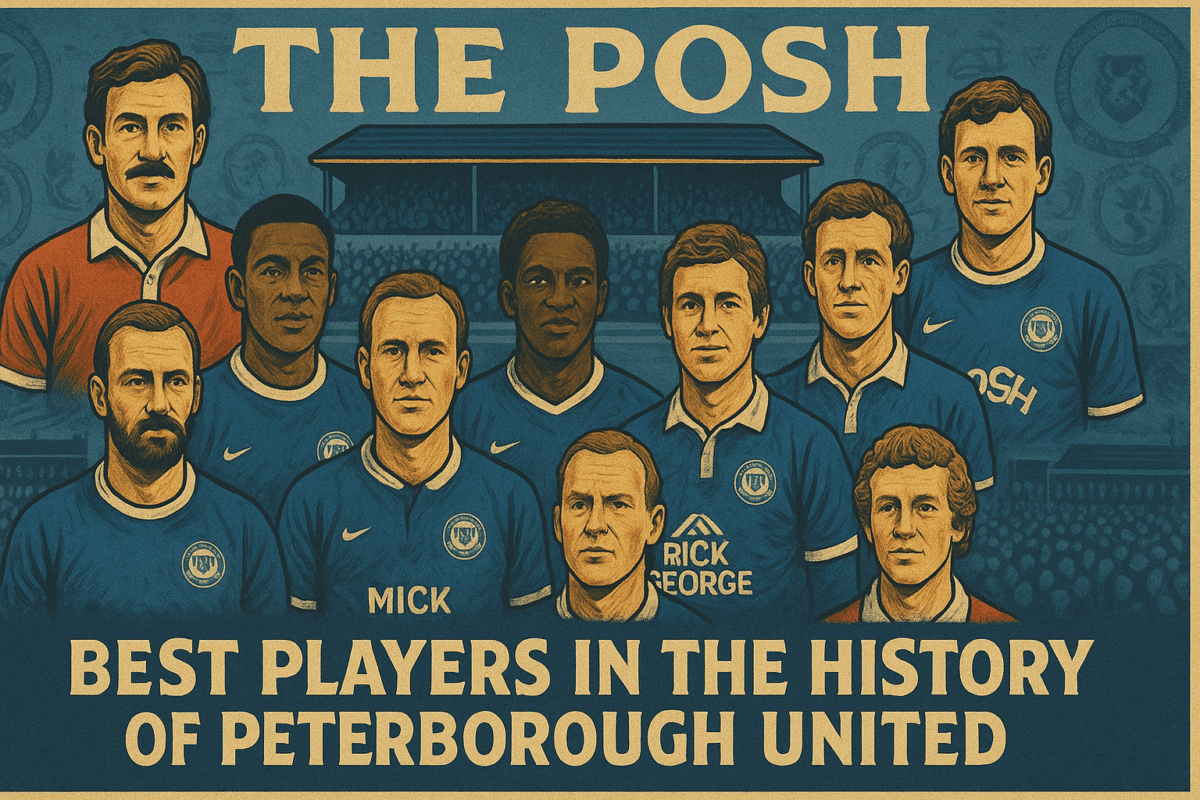
Top 10 Greatest Players in Peterborough United History
From club-record goalscorers to leaders who guided the club through its most successful periods, this list recognises the ten players who have made the most significant impact in Peterborough United colours.
Spanning different eras and playing styles, each player left a lasting legacy—whether through match-winning moments, remarkable consistency, or long-standing loyalty to the Posh.
10. Andy Clarke (1999–2005)
Andy Clarke made a major impact at Peterborough United during his six-year stay from 1999 to 2005, scoring 73 goals in 266 appearances across all competitions. Signed on a free transfer after spells with Wimbledon and loan stints at Port Vale and Northampton Town, Clarke found his scoring touch under Barry Fry. In his first season, he netted 18 goals, including the decisive strike in the 2000 Third Division play-off final at Wembley, sealing promotion with a 1–0 win over Darlington.
Known for his pace and movement, Clarke remained a reliable attacking presence as Peterborough consolidated their place in the Second Division. His standout campaign came in 2002–03, when he scored 19 goals in 48 games. Despite a late-career dip in form, Clarke’s contribution to one of the club’s most memorable promotions, along with consistent goal returns over multiple seasons, make him a worthy inclusion in any list of Posh greats.
9. Ivan Toney (2018–2020)
Ivan Toney’s impact at Peterborough United was short but spectacular. Joining from Newcastle United in 2018, Toney scored 40 goals in 76 league appearances over two seasons and quickly established himself as one of the most prolific strikers in League One. His breakout year came in 2019–20, when he netted 24 goals in 32 games before the season was curtailed due to the COVID-19 pandemic. That tally earned him the League One Golden Boot and saw him named EFL League One Player of the Year.
Known for his strength, aerial dominance, and clinical finishing, Toney was instrumental in turning Peterborough into serious promotion contenders. His performances attracted Championship interest, and he was sold to Brentford in August 2020, where he continued his rise to the Premier League and England honours. Though his time at London Road was brief, his goal ratio and influence make him one of the most impactful strikers in Posh history.
8. Mick Halsall (1987–1993)
Mick Halsall was a key midfield figure for Peterborough United from 1987 to 1993, a period that included the club’s historic rise through the divisions. Joining from Carlisle United, Halsall brought leadership, tenacity, and experience to the heart of the Posh midfield. He made 249 league appearances and scored 28 goals, helping the club secure promotion from the Fourth Division in 1990–91. Halsall’s most significant contribution came in 1991–92, when Peterborough gained promotion to the second tier for the first time in their history via the play-offs.
A hardworking and combative presence, he captained the team during this golden era under manager Chris Turner. Halsall’s influence extended beyond the pitch—he was known for his leadership qualities and ability to motivate those around him. After leaving Peterborough, he later moved into youth coaching and development. His role in back-to-back promotions cements his place as one of the club’s most respected modern-era players.
7. David Farrell (1997–2006)
David Farrell was a consistent and versatile wide player for Peterborough United across nine seasons from 1997 to 2006, amassing 337 league appearances and scoring 42 goals. Signed from Watford, Farrell initially operated as a winger but also featured at left-back and in central midfield, becoming a mainstay through multiple managerial regimes. He was part of the team that won promotion via the Third Division play-offs in 2000, featuring in the final against Darlington.
Known for his crossing ability, stamina, and work ethic, Farrell became a reliable figure throughout a turbulent period in the club’s history that saw both promotions and relegations. His standout campaign came in 2001–02, when he scored 11 league goals. Farrell’s long service, adaptability, and contribution across multiple seasons make him one of the most durable and valuable players to have featured for the club in the Football League era. He departed in 2006 after nearly a decade of loyal service.
6. Freddie Hill (1973–1975)
Freddie Hill brought top-level experience and composure to Peterborough United during his spell between 1973 and 1975. Signed after a distinguished career with Bolton Wanderers and spells at Halifax Town and Manchester City, Hill made 80 league appearances and scored 9 goals for the Posh. Although his time at London Road came late in his playing career, Hill’s impact was notable. A skilful and intelligent midfielder, he used his positional awareness and passing range to control games in the lower divisions.
His presence helped stabilise a squad undergoing changes in the mid-1970s and provided leadership for younger players. Capped twice by England in 1962, Hill remains one of the few full internationals to have played for the club. While not at Peterborough during a promotion campaign or cup run, his pedigree and professionalism elevated the standards around him. Hill retired shortly after leaving the club and passed away in 2021.
5. Chris Turner (1969–1978)
Chris Turner was a commanding defender who played 314 league games for Peterborough United between 1969 and 1978, scoring 37 goals—an impressive return from the back. A tough, dependable figure at the heart of the defence, Turner was also a threat from set pieces, contributing regularly on the scoresheet. His performances earned him a loan move to the NASL with Connecticut Bicentennials in 1977, before he returned to captain Peterborough and conclude nearly a decade of consistent service at London Road.
Turner’s leadership and commitment were defining traits during a steady period for the club, and his total appearances place him among Posh’s all-time top appearance-makers. After leaving, he went on to play in the United States and for clubs such as Luton Town and Cambridge United. He later returned to Peterborough as manager in the early 1990s. Turner passed away in 2015, but remains a revered figure in the club’s history.
4. Ken Charlery (1991–1992, 1993–1995, 1996–1997)
Ken Charlery is one of Peterborough United’s most iconic forwards, known especially for his heroic role in the 1992 Third Division play-off final. Charlery scored twice at Wembley, including a dramatic late winner, to secure promotion to the second tier for the first time in the club’s history. Across three spells at London Road—1991–1992, 1993–1995, and 1996–1997—he made 203 league appearances, scoring 52 goals. Nicknamed “King Ken,” Charlery combined strength, work rate, and big-match temperament, often delivering in crucial moments.
He was named the club’s Player of the Year twice, in 1992 and 1994, reflecting both his on-pitch impact and connection with the fans. His consistent returns and knack for decisive goals made him a fan favourite throughout the 1990s. Beyond his playing career, Charlery later returned to the club in coaching roles, reinforcing his long-standing bond with Peterborough. His legacy at the club is defined by goals, grit, and history-making moments.
3. Jim Hall (1967–1975)
Jim Hall is Peterborough United’s all-time leading goalscorer, netting 122 league goals in 302 appearances during his time at the club between 1967 and 1975. Signed from Northampton Town, Hall quickly established himself as a lethal striker in the lower divisions, known for his sharp movement, instinctive finishing, and aerial prowess. He scored over 20 league goals in three separate seasons, including a career-best 30-goal haul in the 1973–74 campaign.
Hall’s record of 137 goals in all competitions remains unbeaten and is a benchmark for every striker who has followed at London Road. He played through one of Peterborough’s most stable periods in the Football League and consistently delivered at a time when goals were hard-earned. Despite never featuring at the top levels of English football, his legacy at Posh is unmatched in terms of goalscoring output. Hall left the club in 1975 for Lincoln City but remains a towering figure in club history.
2. Terry Bly (1960–1962)
Terry Bly produced one of the most astonishing goalscoring feats in English football history during his time at Peterborough United. Signed from Norwich City in 1960, Bly scored 81 goals in just 88 league appearances across two seasons—an unmatched strike rate in the club’s history. In Posh’s debut Football League campaign (1960–61), Bly scored 52 goals in 46 appearances, helping the club win the Fourth Division title at the first attempt. That remains a Football League record for most goals in a single season by a player in the fourth tier.
Bly’s ability to find space, his clinical finishing, and instinctive positioning made him an unstoppable force during this historic period. He moved on to Coventry City in 1962 but his exploits in that brief spell secured him legendary status at London Road. Bly passed away in 2009, but his 52-goal season remains the defining individual achievement in the club’s history.
1. Tommy Robson (1969–1981)
Tommy Robson is regarded as Peterborough United’s greatest-ever player, having made 559 league appearances and scored 128 goals for the club between 1968 and 1981. Signed from Newcastle United, Robson was a dynamic left winger known for his pace, creativity, and consistency across 13 remarkable seasons. He quickly became a fan favourite for his direct style of play and ability to produce goals from wide areas. His tally of 600 appearances in all competitions remains a club record, and his total goal count is second only to Jim Hall.
Robson played through multiple eras and divisions, always remaining one of the club’s most reliable performers. He was voted into the Posh Hall of Fame and served as a club ambassador in later life. Robson’s long-standing service, attacking brilliance, and unwavering loyalty define him as the ultimate Peterborough United legend. He passed away in 2020, but his legacy remains at the heart of the club’s identity.
Comparison of Peterborough United Legends
Playing Styles and Contributions
Peterborough United’s greatest players span multiple generations, with each era demanding a different style and skillset. For instance, Terry Bly, who dominated the Fourth Division in 1960–61 with 52 goals, thrived in a more direct, physical style of football, often capitalising on crosses and instinctive positioning. In contrast, Ivan Toney, who excelled in League One during 2018–2020, combined athleticism, technique, and modern pressing principles to become the league’s top scorer. The demands of the lower divisions in the 1960s focused more on physical resilience and simplicity, while modern League One football requires technical sharpness, fitness, and tactical intelligence.
Likewise, Tommy Robson embodied the traditional winger of the 1970s—direct, energetic, and creative—whereas David Farrell, though also a wide player, was valued for his versatility and ability to operate in various roles across midfield and defence. This evolution reflects how players adapted to shifting styles, formations, and expectations. Across all eras, what unites these players is their ability to meet the demands of their time while consistently standing out in a Posh shirt.
Impact on Club Success
Many of the players featured were central to Peterborough’s most successful moments. Terry Bly almost single-handedly powered the club to the Fourth Division title in their debut Football League season—setting a standard of excellence that endures to this day. Ken Charlery’s goals in the 1992 play-off final delivered second-tier football for the first time, while Andy Clarke repeated the feat in 2000 with his Wembley winner in the Third Division play-off final. Mick Halsall captained the club through back-to-back promotions, providing vital leadership in midfield.
Jim Hall, Peterborough’s record goalscorer, ensured the club remained competitive throughout the 1970s, while Chris Turner, as a long-serving defender, provided stability and organisation at the back. Even shorter-term stars like Ivan Toney had outsized influence—his goals and performances not only helped Peterborough challenge at the top of League One, but also brought national attention to the club. Collectively, these players didn’t just provide moments of brilliance—they altered the trajectory of Peterborough United’s history.
Records and Achievements
Individual Honours and Awards
Several players on this list earned formal recognition for their contributions. Ivan Toney won the League One Golden Boot in 2019–20 and was named EFL League One Player of the Year for his prolific campaign. Ken Charlery was voted Peterborough United Player of the Year twice—in 1992 and 1994—reflecting his status as a fan favourite across multiple spells. Tommy Robson, the club’s all-time appearance leader, was honoured with inclusion in the Posh Hall of Fame and remains the benchmark for longevity at London Road.
While earlier decades didn’t feature the same volume of individual awards, players like Terry Bly and Jim Hall are remembered for their exceptional statistics. Bly’s record of 52 league goals in a single season remains unmatched, while Hall’s 122 league goals make him the top scorer in club history. These enduring numbers are their own kind of honour—etched permanently into the identity of the club.
Club Milestones and Championships
These ten players were instrumental in many of the most important chapters in Peterborough United’s history. Terry Bly’s historic 1960–61 campaign helped win the Fourth Division title in the club’s first Football League season, a milestone that established Posh as serious competitors. Ken Charlery’s dramatic double at Wembley in 1992 delivered promotion to the second tier for the first time. Andy Clarke’s solitary goal in the 2000 play-off final remains one of the most iconic in the club’s modern era.
Elsewhere, Jim Hall still holds the club record for goals scored in all competitions, and Tommy Robson stands alone atop the all-time appearance list. Mick Halsall captained a squad that achieved successive promotions, while Chris Turner was a key defensive figure during a stable period in the 1970s. These players didn’t just contribute to Peterborough’s success—they were foundational to its very identity, shaping the club’s legacy through goals, leadership, loyalty, and defining moments.