


Introduction to Tactical Formations in Football
Few aspects of football generate as much discussion among analysts and fans as tactical formations. Systems like 4-4-2 and 3-5-2 have come to define eras, influencing how teams defend, attack, and control the rhythm of a match. But understanding these formations is about more than just numbers on a graphic — it’s about grasping the underlying philosophy that shapes a team’s identity.
The 4-4-2, long a staple of English football, is as recognisable as it is straightforward. Comprising four defenders, four midfielders, and two strikers, its balanced structure allowed teams to stay compact, defend solidly, and attack with directness. It was the blueprint for countless sides in the 1980s and 1990s, from Graham Taylor’s Watford to Sir Alex Ferguson’s early Manchester United teams. In lower leagues, especially, the 4-4-2 provided tactical clarity in chaotic conditions, thriving on discipline, work rate, and effective wide play.
However, as the pace of the game accelerated and midfield control became more prized, formations had to evolve. Enter the 3-5-2 — a system that initially raised eyebrows but has since been embraced by managers seeking flexibility and central dominance. By fielding three central defenders and wing-backs, the 3-5-2 offers numerical superiority in midfield, width without sacrificing shape, and greater adaptability in both attack and defence. It’s no coincidence that clubs at various levels of the English football pyramid — from Chris Wilder’s Sheffield United to Steve Cotterill’s Shrewsbury Town — have adopted variations of the shape to outmanoeuvre rigid opposition.
This shift from rigid to fluid systems reflects the broader tactical evolution within the game. Where once formations were static, now they are dynamic, changing in and out of possession. Coaches no longer speak only of ‘formation’ but of ‘structures’ and ‘principles’, recognising that flexibility is key in a game increasingly dominated by fine margins.
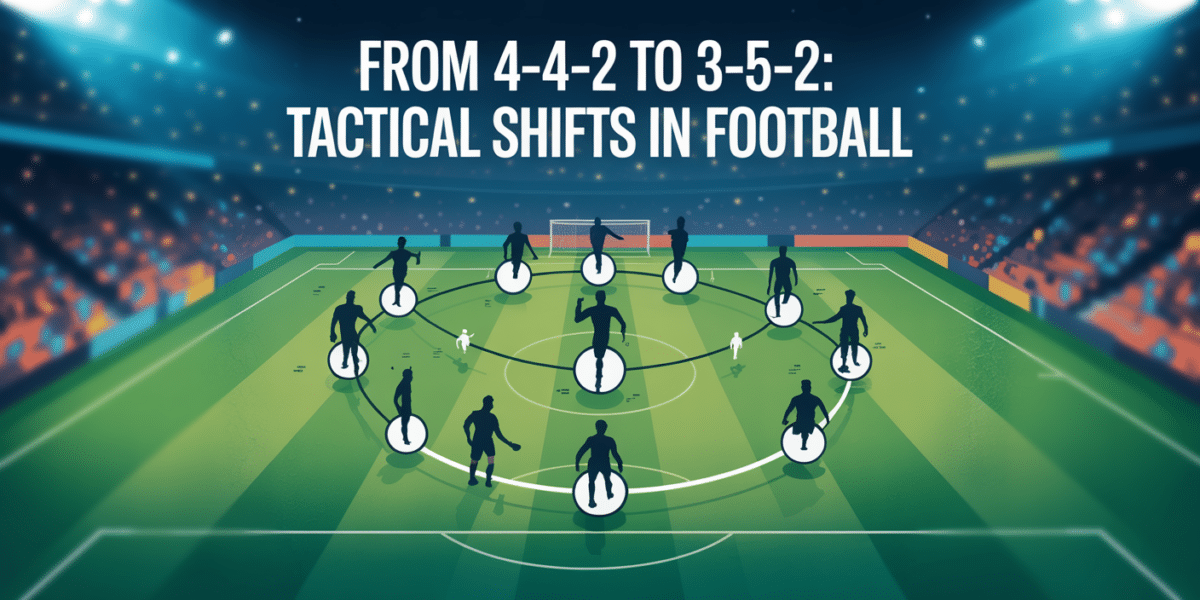
The Strategic Advantages of the 3-5-2 Formation
The rise of the 3-5-2 formation in modern football reflects a desire for tactical balance — a system that can offer both defensive solidity and attacking variety without compromising shape. Once seen as a niche or reactive setup, 3-5-2 is now a proactive choice for managers who want to dictate play and dominate key areas of the pitch.
At the heart of its appeal is offensive versatility. The formation naturally creates overloads in midfield, with three central players able to control possession and dictate tempo. This is particularly useful in the EFL, where many sides favour compact defensive blocks. By fielding two strikers, the 3-5-2 also maintains a constant threat in behind, ensuring defenders are stretched. One forward can drop deeper to link play, while the other runs the channels — a dynamic that unsettles centre-halves used to marking a single number nine.
The attacking contribution of wing-backs is arguably the system’s most defining feature. Positioned high and wide, they provide natural width and often function as auxiliary wingers, delivering crosses or cutting inside depending on tactical instruction. This dual role requires immense stamina and tactical awareness — traits increasingly valued in the modern game. Players like Rhys Norrington-Davies at Sheffield United or Sorba Thomas during his Huddersfield Town peak demonstrate how the right wing-backs can be transformational at Championship and League One level.
Defensively, the 3-5-2 offers notable advantages as well. The trio of centre-backs creates a compact unit, allowing for effective zonal marking and swift cover when dealing with balls over the top or wide deliveries. Meanwhile, the wing-backs can drop into a back five when out of possession, making the system robust against wide attacks. It’s a shape that provides natural depth, reducing exposure to quick transitions — a common threat in the high-tempo environment of the EFL.
In essence, the 3-5-2 is as much a philosophy as a formation. It blends modern tactical thinking with traditional football principles — a shape that rewards energy, awareness, and cohesion. When executed well, it gives sides the tools to control matches without sacrificing defensive discipline or attacking flair.
Transitioning from 4-4-2 to 3-5-2: Key Considerations
Moving from a traditional 4-4-2 to a more complex 3-5-2 requires more than simply shifting a player into defence or midfield — it involves a wholesale reassessment of team structure, player roles, and in-game responsibilities. The tactical shift can rejuvenate a side, but only when carefully implemented with the right personnel and training.
The most immediate change is the back three. While 4-4-2 relies on a centre-back partnership protected by a flat midfield, 3-5-2 demands a trio that is positionally disciplined and comfortable on the ball. The outer centre-backs often step into wide areas to support wing-backs or track opposition wingers — roles that require mobility, anticipation, and composure. Teams at EFL level often turn to full-backs or athletic defenders to fill these roles, allowing for better coverage and ball progression.
In midfield, the change is even more significant. The 4-4-2 typically fields two central midfielders tasked with covering large areas, often leading to a battle for control in games where the opposition floods the middle. By contrast, 3-5-2 introduces a third central player — often a holding midfielder such as Ethan Erhahon at Lincoln City — who allows the other two to push higher or wider. This extra man can be the key to unlocking compact defensive setups, offering numerical superiority and improved passing angles through the thirds.
However, implementing a 3-5-2 also requires players to embrace new responsibilities. Traditional wingers may struggle to adapt, while full-backs must adjust to the dual nature of the wing-back role — part defender, part winger. Similarly, forwards who thrived in a lone-striker role within a 4-4-2 must learn to combine with a partner, working on movement, link-up play, and off-the-ball runs. Coaches must invest time on the training ground to instil these patterns, often relying on video analysis and positional drills to reinforce understanding.
Not every squad is suited to a 3-5-2 immediately, and failed transitions can lead to tactical confusion. But when executed with the right blend of personnel and patience, the shift from 4-4-2 to 3-5-2 can unlock a new dimension — one that reflects the evolving tactical intelligence of the modern EFL side.
Insights into Tactical Flexibility
Modern football demands adaptability, and one of the great strengths of the 3-5-2 formation is its inherent flexibility. Far from being a fixed blueprint, the shape allows for numerous in-game adjustments, making it ideal for teams looking to impose themselves or react to different scenarios.
Managers can tweak the system to suit their tactical vision — switching to a 5-3-2 out of possession for extra defensive cover, or morphing into a 3-4-1-2 when chasing a game by pushing one midfielder further forward into a creative role. These adaptations help sides remain unpredictable and tactically fluid, which is vital in the EFL’s congested fixture calendar where opponents quickly learn each other’s patterns.
The effectiveness of any formation, however, hinges on the qualities of the players within it. A back three, for instance, is only as strong as the defenders’ ability to read danger and distribute under pressure. Similarly, wing-backs must possess exceptional endurance, positional awareness, and technical skill — without them, the system can become flat or unbalanced. Central midfielders, too, play a pivotal role: the presence of a deep-lying playmaker or an aggressive box-to-box runner can drastically alter how the team builds and defends.
What sets successful 3-5-2 sides apart is not just the formation itself, but how they use it as a framework — not a constraint. The best managers coach principles rather than rigid shapes, allowing players to express themselves within a well-drilled tactical context. That balance of structure and spontaneity is what defines tactical flexibility at its best.
Comparative Analysis: 4-4-2 vs 3-5-2
Comparing 4-4-2 and 3-5-2 reveals the evolution of football’s tactical priorities. Where 4-4-2 once dominated through its simplicity and symmetry, the 3-5-2 reflects a shift toward central dominance, fluidity, and defensive variation.
The 4-4-2 remains an effective setup for teams that thrive on organisation, wide play, and direct attacking. Its compact lines make it easy to drill, making it a favourite in the lower leagues and with sides lacking specialist players. However, its biggest weakness is often in midfield. Against modern systems that use three or even four central midfielders, 4-4-2 can be overrun, especially when pressing is poorly coordinated or when opponents dominate possession.
The 3-5-2, by contrast, prioritises midfield control and wing-back dynamism. It suits teams with strong tactical discipline and athletic players capable of switching roles mid-match. This flexibility can overwhelm sides stuck in a flat back four or a rigid midfield pairing. However, it is not without flaws. If wing-backs are pinned back by aggressive wide players, the system can quickly resemble a defensive 5-3-2, blunting attacking momentum.
There are several recent EFL case studies that highlight this contrast. Chris Wilder’s Sheffield United famously used an overlapping centre-back variation of the 3-5-2 to earn promotion and compete in the Premier League. Likewise, Luton Town under Nathan Jones and Rob Edwards demonstrated how intelligent use of wing-backs and compact midfield lines can maximise performance on limited budgets.
Meanwhile, traditionalists like Neil Warnock or John Coleman have stuck with versions of the 4-4-2, drawing success from clarity and commitment to wide play — a reminder that no system is obsolete, only less suited to certain squads or scenarios.
Practical Implementation of 3-5-2 on the Field
Implementing a 3-5-2 formation effectively requires more than tactical theory — it demands meticulous coaching, clear communication, and a deep understanding of player roles. For EFL clubs and lower-league managers, the success of such a transition often rests on how well the squad absorbs the system’s nuances during training sessions and under match pressure.
One of the first priorities is ensuring defensive cohesion. Coaches must work extensively with the back three to maintain shape, cover wide areas, and communicate effectively. Central defenders need to understand their individual and collective positioning — particularly the outer centre-backs, who must anticipate overlaps and step into midfield when required. Defensive drills that simulate counter-attacks, quick switches of play, and aerial duels are essential.
Equally important is the integration of wing-backs. Many teams falter here, either by selecting players unsuited to the physical and tactical demands, or by failing to give them sufficient instruction. Wing-backs must be given the freedom to advance but also drilled in when and how to retreat, ensuring the formation doesn’t collapse into an ineffective back five. Fitness conditioning, positional walkthroughs, and video analysis can all aid in reinforcing these responsibilities.
Midfield structure requires careful attention. Coaches should define the roles within the trio — whether it’s a sitter-flanker-runner model, or a more fluid carousel. Common pitfalls include lack of vertical support to the forwards or too much spacing between lines, which can expose the defence or stifle attacking rhythm. Pre-season is the ideal time to experiment with combinations, with emphasis placed on pressing triggers, ball circulation, and transitional movement.
Among the most frequent mistakes during a 3-5-2 transition is asking square pegs to fill round holes. A team without natural wing-backs or mobile centre-halves will struggle to sustain balance. Others fall into the trap of overcomplicating things too quickly — layering tactical shifts without establishing a clear base shape. The most successful implementations begin with simplicity: a defined structure, positional repetition, and clear expectations.
Ultimately, the 3-5-2 can be a powerful asset when executed with precision and patience. It rewards coaches who invest in tactical education and players willing to embrace adaptability. With the right groundwork, even clubs in the most demanding corners of the EFL can use it to gain a competitive edge — not just by changing shape, but by changing the way they control the game.
Advanced Tactical Considerations
As football tactics evolve, so too does the language used to describe them. Coaches and analysts no longer speak solely in formations, but in terms of “rest defence”, “half-spaces”, “transitional moments”, and “pressing triggers”. Understanding these modern tactical concepts is essential for teams hoping to unlock the full potential of a 3-5-2 setup.
One such concept is rest defence — the structure a team holds behind the ball when in possession. In a 3-5-2, this often takes the form of a back three supported by a sitting midfielder, ensuring the side is not caught out by quick transitions. This tactical insurance allows wing-backs and midfielders to attack with greater freedom, knowing there is balance behind them.
Another key idea is occupying the half-spaces — the vertical channels between full-back and centre-back that are often hard to defend. In a 3-5-2, attacking midfielders or wide centre-backs can exploit these spaces, especially when opponents are caught in a narrow block. These subtle positioning cues can be the difference between sterile possession and meaningful penetration.
Set pieces also take on unique tactical importance in a 3-5-2 system. With three central defenders on the pitch, sides often have a natural aerial advantage, particularly at EFL level where dead-ball situations can swing entire seasons. Well-drilled routines — both offensive and defensive — are critical. A well-weighted delivery to the back post or a cleverly disguised short corner can be devastating when executed by players who understand their roles.
Defensively, the compact nature of the 3-5-2 allows teams to zone effectively while retaining man-marking options, giving flexibility when defending corners or free-kicks. Coaches can adjust based on the opposition threat — stacking the six-yard box against physical teams or setting up for second balls against sides who play short.
Ultimately, the sophistication of a team’s 3-5-2 lies in how these advanced ideas are woven into the fabric of training and matchday execution. For clubs in the EFL, where marginal gains often separate mid-table anonymity from promotion pushes, embracing modern tactical language and applying it practically can give an edge that goes far beyond formation alone.


